Showing posts with label art history. Show all posts

Wednesday, June 5, 2013

Teaching elementary students about early medieval art

A week after introducing elementary school students to the early middle ages I returned to the school to lead the students in an art project inspired by the time period.  The curriculum recommended teaching the students to make a mosaic inspired by those found in Byzantium.   I disliked the idea for two reasons:  first, I thought that supervising 30 kids with cement was, frankly, frightening; and second, there was once again a mismatch between the era covered during the history portion of the unit and the era covered during the art portion of the unit (this entry covers more detail on this, and also gives two possible reasons for the shortcomings in elementary level art-history curriculums).  The history portion of the Dark Ages unit had emphasized the history of England during the Anglo-Saxon period (see herehere for my lesson plan), but mosaics were unknown anywhere in either northern or western Europe during this time period.  Mosaics existed in Byzantium at this time, but the cultures of Germanic Europe and the Byzantine Empire were completely different.  When planning the lesson, I needed to either ignore the discrepancy or to choose which lesson to throw out and rewrite. 

An example of Anglo-Saxon cloisonne
Hilt fitting from the Staffordshire Hoard
Source:  Wikimedia Commons
Resolving these two issues ended up being easier than I had feared.  While looking at pictures of early medieval Germanic art I realized that the Anglo-Saxon cloisonné actually looked quite a bit like mosaic, set in gold rather than cement.  I also found the website of an artist who routinely teaches mosaic-making in classrooms, and she mentioned that aquarium gravel will stick to heavy paper with mod podge.  These discoveries gave me the basis of a plan.  I ditched the mosaic patterns based on Byzantine art, substituting my own (very basic) pattern of a Germanic brooch.  Then, instead of mixing cement or plaster of paris for the kids to use with their colored aquarium gravel, I supplied the kids with enough mod podge to decorate their brooches however they wanted. 

What went well.  The older students (fifth graders), particularly, appreciated the creativity of being able to decorate the brooches however they wanted.  The aquarium gravel did stick to the construction paper just fine as long as the students applied the mod podge liberally, and since I also had them glue the construction paper to a paper plate, the finished art project was not so heavy as to bend the paper (cardstock or cardboard would be a good alternative).

What didn’t go so well.  The younger students (second graders) did an easier version of the project, using scraps of paper and school glue instead of gravel and mod podge.  Even so, they needed more structure than I initially gave them.  Next time I will give them a more detailed pattern that they will simply fill in rather than expecting them to choose how to decorate the brooches themselves.  I will also bring fewer examples and fewer paper colors, because the younger students found the number of choices overwhelming.  Finally, following the curriculum, I taught the students about the color wheel and high- and low-contrast colors.  Both sets of students grasped the concept quickly, but neither group understood how to apply their new knowledge to the art project they made, even with my examples.  I’m not sure how to fix this problem short of giving the kids the specific instruction, “use high-contrast colors in your project.”  I don’t like this approach, though, because while the kids would make better art, they still won’t have learned why their art was better.


Final thoughts.  After the fun of teaching the history portion, teaching this portion was much more humbling.  I should have been more prepared for the second grade class, and anticipated their need for structure.  First graders (six- and seven-year-olds), I have learned, are very creative and need almost no structure at all.  I’ve also noticed that about the time a child turns eight, they become very aware of rules and are afraid to break them, so a third-grade class needs a lot of structure.  A Second-grade class is difficult to teach because some of the students have made the transition to an eight-year-old mindset, but the younger students still want the freedom of a first grader.  Since I taught this lesson in May, however, I should have realized that nearly all the class would want rules and I should have planned my lesson accordingly.  I will remember this the next time I teach this age group.

Monday, May 20, 2013

Teaching elementary school students about early Medieval culture

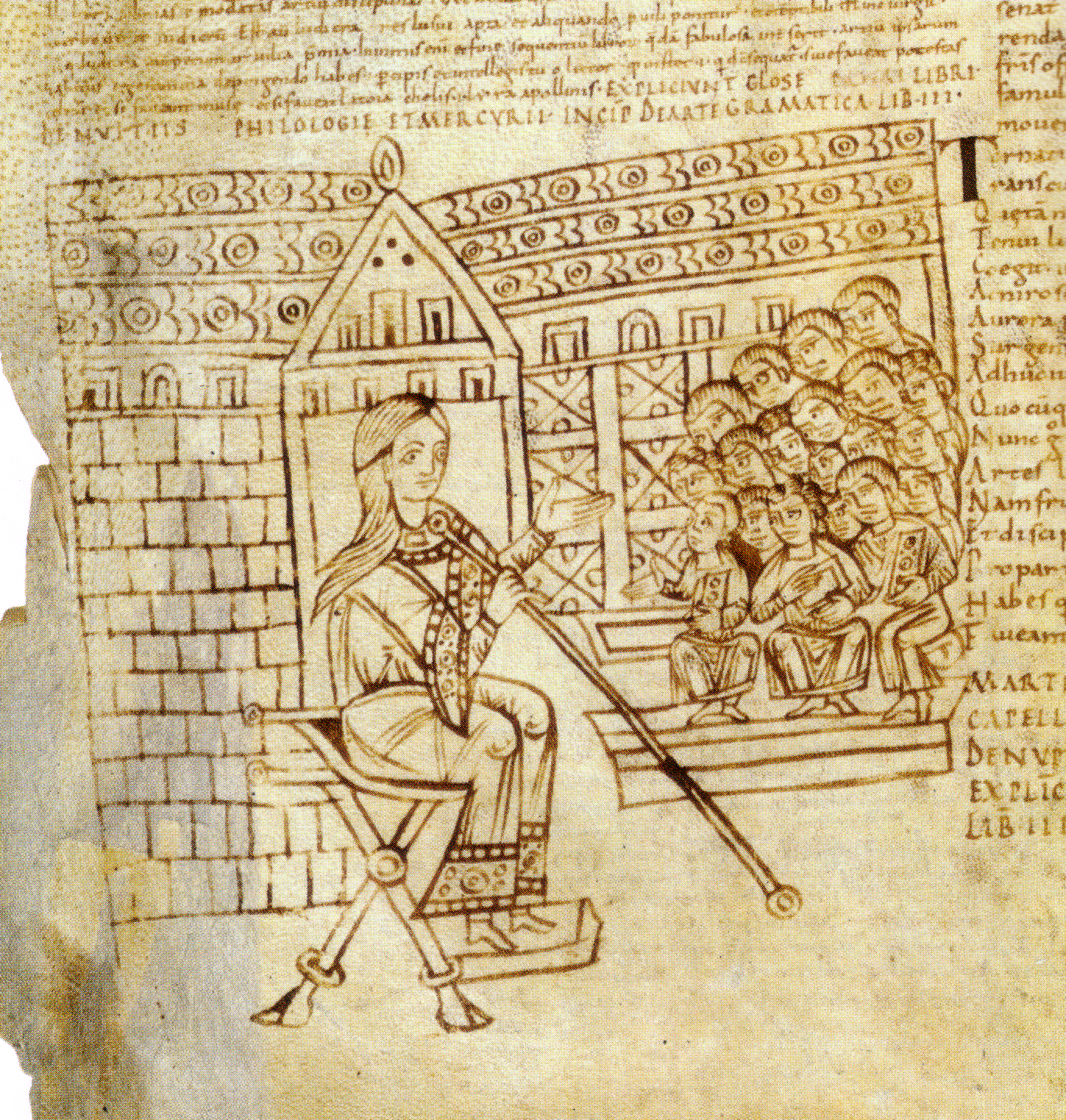
Lady Grammatica teaches Latin on a 10th c. Carolingian manuscript
Image Source:  wikimedia commons
 During April 2013 I taught art history to fifth- and second-grade classrooms.  The unit was the Dark Ages.  What follows is the lesson plan I created and used to teach the history/culture of the time period.  A later post will contain the lesson plan I created and used to teach the art of the time period.

Teacher:  I ask you all, why are you so eager to learn?
Students:  Because we would not be foolish, as cattle, knowing nothing but grass and water.
Teacher:  And what would you be instead?
Students:  We would be wise.
Taken from OE version of Aelfric’s Colloquy; translation mine.

Objective:  To introduce elementary school students to the culture of Early Medieval Europe, specifically that of Anglo-Saxon England.

Preparation:  Before class begins, divide the class into 3 groups by placing one of 3 colored sticky notes underneath each desk/chair. 

Attention activity:  Introduce the time period with a quiz.  For the younger grades, use this worksheet from BBC Primary History.  For the older grades, use a true/false/trick question quiz:
1.       During the middle ages, people ate rotten meat because they had no refrigeration.  They heavily spiced their food to hide the rotten flavor.  (False)
2.       During the middle ages, both boys and girls could learn to read and write. (True)
3.       During the early middle ages, houses did not have fireplaces or chimneys.  Instead, they had a hearth in the middle of the room and a hole in the roof for smoke to escape.   (True)
4.       Before Columbus, Europeans believed the world was flat and if a ship sailed too far it would fall off the edge.  (False)
5.       The Roman Empire fell ca. 500 AD.  (Trick question:  Only the Western half of the Roman Empire fell then.  The Eastern Roman Empire continued intact until the fall of Constantinople in 1453)

Discussion:  Northern Europe experienced a power vacuum with the collapse of the Western Roman Empire.  Ask: if the government of your hometown was suddenly gone, and you could set up any kind of society you wanted, how would you do it?  Introduce King Aelfred.  He described the Anglo-Saxon society as made up of 3 groups:  Those who fight, those who pray, and those who work.  Tell the students to find their sticky note to learn which group they are in today.
My second grader as aetheling.

Those who fight.  Ask one group of kids to stand up.  They represent the thanes, or the nobility.  When the king dies, the thanes elected a new king.  Pick one student from the group to be the tribe’s king (the “thanes” in the older grades can do this themselves).  Give the “king” the mail shirt.  The job of the king was to protect the people.  The thanes gave fealty to the king, which meant they promised to fight for him and, if he were killed in battle, they promised that they would die alongside their king.  In exchange, the king gave the thanes land, food, and arm rings. 

My fifth grade daughter posing as abbess.
Those who pray.  Tell the students in this group that they belong to a double monastery (this means both men and women lived there), and Anglo-Saxon double monasteries were always ruled by an abbess, elected by the monks and nuns.  Choose a girl to be the abbess (again, the older kids can do this themselves).  Dress the “abbess” in a cloak and hood.  Explain to the students in this group that their job is to pray, sing hymns, and perform masses on behalf of their tribe.  This way, the tribe will be in God’s favor.

Teacher:  Wise man, which craft among these seems to be the greatest?
Wise man:  It seems to me God’s service is sovereign of these crafts, just as one reads in the Gospel,  “First seek God’s kingdom and His righteousness, and all these things will be added to you.”
Teacher:  Which seems to you sovereign of the worldly crafts?
Wise man:  Farming, for the plowman feeds us all.
Taken from the OE version of Aelfric’s Colloquy; translation mine.

Those who work.  Tell the third group of students that they represent everybody else.  Some are slaves, some freemen.    Choose one of the students to wear a peplos style overdress.  Use Aelfric’s colloquy to introduce Anglo-Saxon occupations. 
My fifth grader, again, this time modeling an overdress.

Aelfric’s Colloquy.  Aelfric was a monk who taught Latin classes about the year 1000.  He wrote his Colloquy in Latin to help his students practice, and also wrote a vernacular (Old English) translation.  The Colloquy presents life in an Anglo-Saxon village at Aelfric’s time.  The various parts of the Colloquy, presumably assigned to various students in his class, represent villagers who perform occupations that Aelfric’s students would have been familiar with.  A modern English translation of the Latin version can be found here.  

(An aside:  As written, the entire Colloquy takes about 30 minutes to read, far too long for most elementary age kids’ attention spans, so I recommend abridging it.  I cut more out of the version I read to the second graders, and I also reworded some of the passages.  For the fifth graders, I cut out only the redundant passages, and assigned parts like Aelfric probably did, so the fifth graders presented a readers’ theater with me reading the teacher’s parts.  During the presentation in both classes I showed pictures from an Anglo-Saxon calendar illustrating many of the occupations.  The pictures helped keep smaller attention spans from wandering too much. The calendar is in the collections of the British Library, and images can be viewed at the National Education Network,  gallery.nen.gov.uk.  Search for "Anglo-Saxon labours of the month." )

What I learned/what I would do differently:  I meant the quiz at the beginning of the lesson to be merely an introduction to the subject as well as a fun activity to catch the kids’ attention.  It ended  up being essential to my teaching, because I used it to gauge how much the students already knew about the time period.  Answer:  practically nothing, and what they thought they knew was wrong.  This showed me quickly that I could assume no prior knowledge and had to keep the entire presentation basic. 

I was surprised at how well the costumes worked as a teaching tool.  Even the older kids enjoyed dressing up, and the students who didn't get to dress up still wanted to check out the costumes. 

Next time I will change the way I teach the Colloquy to the younger students.  The fifth graders had a good time with the readers’ theater, but the eight-year-olds do not yet have the reading skills necessary for that, so I presented the entire Colloquy myself. Even heavily abridged, it was too much lecture.  I need to find a way to include more participation.  Perhaps I will just show the pictures from the calendar and ask questions about them:  What do you think this person is doing?  What could the farmer  be growing?  What other animals might the hunter want to catch?  Etc. 

Final thoughts.  I really enjoy this time period.  Vikings, knights, Beowulf—what’s not to enjoy?  For me, the most difficult part of preparing the lesson was narrowing down what I wanted to teach.  Six hundred years is tough to cram into sixty minutes, let alone six hundred years covering the withdrawal of Rome to the Germanic tribes’ invasions to the birth of England to the Norman Conquest, as well as the changes in national and religious identity that accompanied the political changes.  Complicating this is the fact that the modern view of the middle ages, a la Dungeons and Dragons, is fun but anachronistic.  I finally decided that the kids weren’t going to remember much of the history I taught them anyway, and so I concentrated on the culture.  I’m rather pleased with the way it turned out.  I got the students to think about different ways of setting up governments.  The older students even discussed, on their own, the ethics of a king expecting thanes to die for him.  And eight-year-olds in too-big chain mail shirts are dang cute.  

Update (6/5/13):  A week after this lesson I taught the classes again, leading the students in an art project inspired by early medieval art (see here for more information).  I was afraid that the second graders would finish early, so I had an additional activity for them to do before we began the art project.
This is what we did:  I set on the floor enough sheets of construction paper for each child to be able to turn one over.  About half of the papers had a picture of an Anglo-Saxon artifact paper-clipped to the back of the construction paper; the others had a blank white sheet paper-clipped to the back.  I showed the students an Indiana Jones hat and told the students that they were archaeologists and they were going to dig for objects by turning over pieces of construction paper.  One at a time, the students came to the front of the room,  put on the hat, and chose a place to “dig” by turning over a piece of paper.  If they found an artifact, the class guessed what the object might be.  The kids really got into it.  They called each other “Indiana (name)” and whenever a piece of paper was blank underneath they exclaimed, “Oh, no, you found a booby trap!” instead of being disappointed.
As it turned out, the students didn’t have enough time to finish their art, so next time I won’t add the activity to the second week.  However, the students had such a good time, and since the Colloquy didn’t work well for the younger kids, I think I would substitute this for reading the Colloquy in the younger classes.  

Tuesday, February 5, 2013

Qin Dynasty: My introduction to the history of Asia

Our elementary school's PTA sponsors an art history program.  Parent volunteers come into their kids' classrooms about once a month to teach the units.  This is one of my favorite things to do.  I get to learn something new, and then share what I've learned (which, come to think about it, is a lot like this blog).

This month was my turn to teach. I taught 5th and the 2d graders about the Qin Dynasty of China.  I felt  intimidated because I knew practically nothing about Asian history. I spent about a week beforehand cramming like a college student before final exams, learning everything I could.  This is what I discovered:

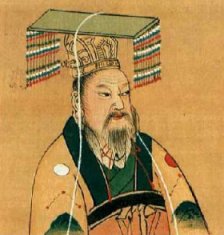
Emperor Qin Shi Huang
Source:  Wikimedia Commons
Me:  What do you know about China?
2d grader:  They used to have a ruler.
Me:  Yes, do you know what the ruler of China was called?
2d  grader in the back:  PHIL!

Qin (pronounced "chin") was one of several states that fought during the Chinese "warring states period" (ca. 475 BCE-221 BCE).  When the fighting was over, Qin had won, taking over the other warring states.  This was the beginning of what would eventually become the modern Chinese State.  In fact, the western name for the country, "China," probably comes from the name "Qin."

5th grader (musing):  Hey . . . Qin . . . Quin-ah . . . China.

The ruler of Qin State, Qin Shi Huang, declared himself the first emperor of China.  He had the task of uniting the various Chinese states into one Chinese Empire.  He accomplished this by dismantling the smaller walls between the states and replacing them with one Great Wall; by altering the promotion systems in the army and the bureaucracy from one based on noble status to one based on merit; and by uniting the various systems of writing, measurement, and money into one empire-wide system.

Our country is made up of lots of states, too.  Why is it that we all see ourselves as Americans instead of citizens of Utah, Wisconsin, South Carolina, etc.?
5th grader:  Well, we don't fight wars with people of other states.
Me:  Why not, do you think?
5th grade consensus:  Because we all work together to do things and we all have the same enemies.  

Emperor Qin's reforms made a lot of people happy, but they also made a lot of enemies.  The old aristocracy was not pleased that bureaucratic and military promotions were now based on merit.  He also angered a lot of people through his book-burning program:  Emperor Qin did not approve of the teachings of  Confucius.  After 3 assassination attempts, Emperor Qin grew paranoid.  He hired alchemists to search for the philosopher's stone and create an elixir of life.  He did escape assassination, however, eventually dying of old age.
Several of Emperor Qin's terracotta warriors on display in the Xian Terracotta Warriors Museum.
Source:  Wikimedia Commons

Disappointed 5th grader:  What, nobody successfully killed him?

Emperor Qin had built himself an elaborate tomb just in case he didn't make it to immortality.  He was buried under a man-made hill, inside a necropolis which supposedly contains palaces, towers, rivers of mercury, and replicas of constellations.  Chinese archaeologists have found the burial site, but have not excavated due to concerns about preservation of the relics.  Tantalizingly, the earth making up the burial site does contain higher levels of mercury than the surrounding earth, suggesting the tomb's description may be based on truth.  Archaeologists have dug trenches in the area around the tomb, finding an estimated 8,000 terracotta warriors guarding the entrance.  The warriors are life-size and individual--they have different faces and hairstyles, and different uniforms based on the warrior's rank.  Originally, they held bronze weapons.  Some had terracotta horses, others chariots.

2d grader: That is kind of like the elaborate tombs in Egypt!  I know a lot about Egypt and a lot about China because my dad and I watch the history channel.


Links I found helpful:

  • The Metropolitan Museum of Art.  This website has a timeline of art history which includes a discussion of the Qin Dynasty.
  • The Asian Art Museum (San Francisco).  The museum's website is targeted toward teachers.  Visitors can download information packets containing lesson materials.  I used the packets with information about ancient China.
  • Asia for Educators (Columbia University).  The week after teaching about the history of the time period, volunteers return to the classroom to lead the students in an art project.  I used this website as the basis for the 2d week's introduction of Chinese calligraphy in the 5th grade class (it was too complicated for the 2d graders).
  • http://www.archchinese.com/.  This website, intended for students of Mandarin Chinese at schools and universities in the United States, has animated stroke orders for 7,000 Chinese characters.  

Finally, Japanese mahjong.  There is an episode of Star Trek:  The Original Series in which Kirk teaches a gambling game (Fizzbin) to mobsters in order to distract them.  He makes up the rules on the fly, and they are enormously complicated.  This game reminds me of Fizzbin.  The flash game is the Japanese variant of the four-player game, and I still can't remember all the hands or understand the point system, but I've had a lot of fun trying to figure it out.