Showing posts with label history of Christianity. Show all posts

Sunday, August 4, 2013

He seemed to kindle with fervor: A window into the Second Great Awakening via Washington Irving

I teach Relief Society.  It’s fun.  More fun than teaching Primary, anyway.  Grown-ups don’t test the limits by trying to jump out the window or build forts out of chairs during the lesson.

Teaching from the Teachings of Presidents of the Church series 1 led me to research a time period I knew almost nothing about:  the time period often called Jacksonian America (roughly 1815-1848).   The lesson manual contains only direct quotes from President Lorenzo Snow.  This is enough to tell me what President Snow thought about, for example, grace.  If I want to know why he believed what he thought about grace, or even why he was concerned about grace to begin with, it helps to understand what Americans in general thought about grace at the time President Snow lived.  I’ve come to a deeper understanding about my church’s theology as I have studied how it fits into the bigger picture of American Christianity.
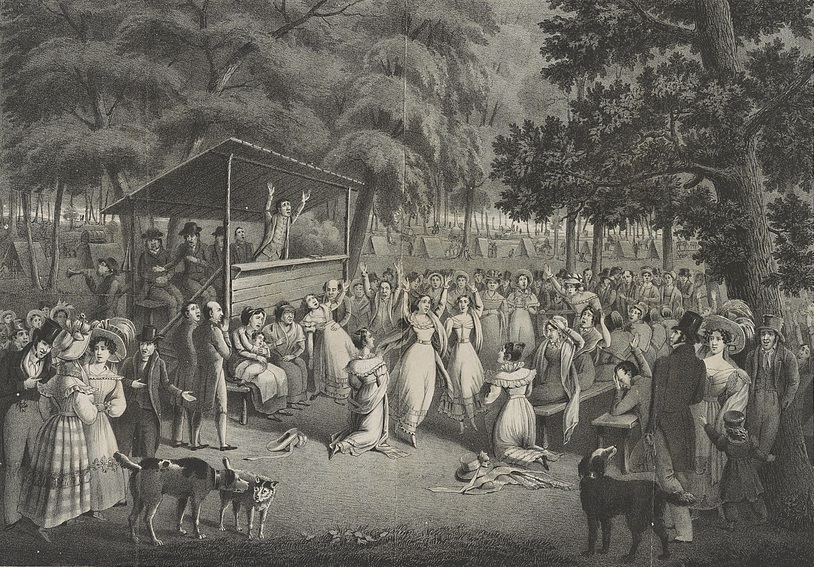
Lithograph by H. Bridport, ca. 1830
From Wikimedia Commons
Note the women overcome by the Spirit upon conversion

Which brings me to America's Second Great Awakening.    The First Amendment to the US Constitution prohibited establishment of religion, but this applied only to the federal, not the state governments.  In the early 1800s, many states disestablished churches, resulting in more of an open marketplace of religious ideas.  People began comparing churches, looking for one they believed taught true Christian doctrine.   This increase in religious fervor is called the Second Great Awakening. 

 One thing I find really interesting about the Second Great Awakening was the expected conversion experience.  Churches at this time typically proselyted to religious seekers using revivals.  People attended revival meetings hoping to have a conversion experience, in which they would be called by Jesus Christ and saved by his grace.  Rather than looking for a church that answered specific theological questions or a church that makes them feel welcome, as many who look for truth do today, 2 seekers then were looking for a sudden, overwhelming supernatural manifestation of God’s love and forgiveness.  And they expected to get it.
Washington Irving and his Literary Friends at Sunnyside
1864 Painting by Cristian Schussele (from Wikimedia Commons)
Irving is seated, center, facing the viewer

As I learned more about Jacksonian America, I wanted to get a feel for what the Americans who lived then were concerned about.   I decided to read some of the things they read.  In the middle of a collection of short stories written by Washington Irving (originally published between 1819 and 1855), I ran across a description of a character’s conversion experience.  I enjoyed it so much I thought I would share it:

The carnival passed away; the time of Lent succeeded; passion-week arrived; we attended one evening a solemn service in one of the churches, in the course of which a grand piece of vocal and instrumental music was performed relating to the death of our Saviour.
I had remarked that he was always powerfully affected by music; on this occasion he was so in an extraordinary degree.  As the pealing notes swelled through the lofty aisles, he seemed to kindle with fervor; his eyes rolled upwards, until nothing but the whites were visible; his hands were clasped together, until the fingers were deeply imprinted in the flesh.  When the music expressed the dying agony, his face gradually sank upon his knees; and at the touching words resounding through the church, “Jesu mori,” sobs burst from him uncontrolled—I had never seen him weep before.  His had always been agony rather than sorrow.  I augered well from the circumstance, and let him weep on uninterrupted.  When the service was ended we left the church.  He hung on my arm as we walked homewards with something of a softer and more subdued manner, instead of that nervous agitation I had been accustomed to witness.  He alluded to the service we had heard.  “Music,” said he, “is indeed the voice of heaven; never before have I felt more impressed by the story of the atonement of our Saviour.—Yes, my friend,” said he, clasping his hands with a kind of transport, “I know that my Redeemer liveth!”
From Adventure of the Mysterious Stranger
Published 1824, in Tales of a Traveler


1. Ebooks of the series can be found here (scroll down).
2. See CNN opinion piece here

Monday, May 20, 2013

Teaching elementary school students about early Medieval culture

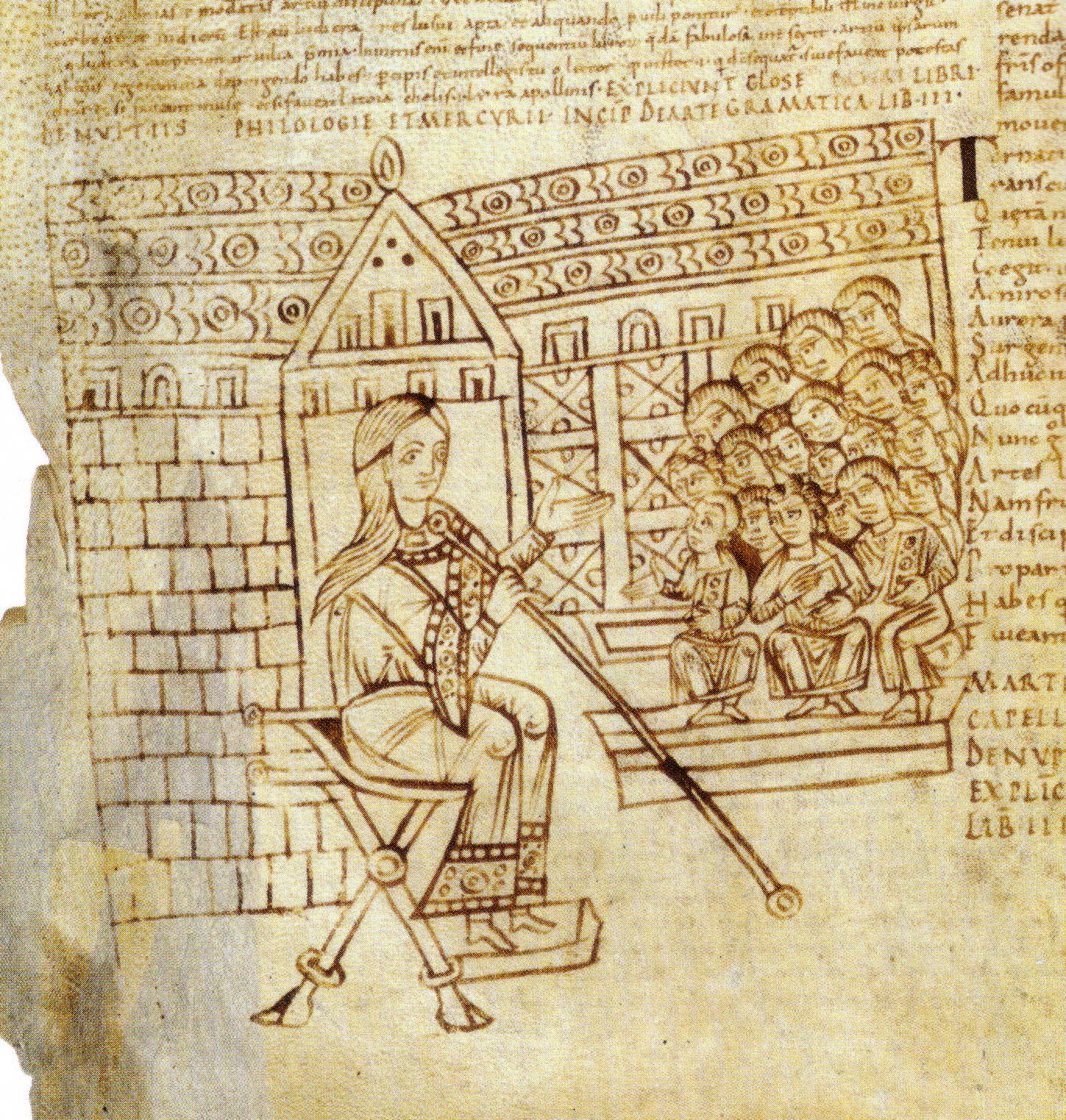
Lady Grammatica teaches Latin on a 10th c. Carolingian manuscript
Image Source:  wikimedia commons
 During April 2013 I taught art history to fifth- and second-grade classrooms.  The unit was the Dark Ages.  What follows is the lesson plan I created and used to teach the history/culture of the time period.  A later post will contain the lesson plan I created and used to teach the art of the time period.

Teacher:  I ask you all, why are you so eager to learn?
Students:  Because we would not be foolish, as cattle, knowing nothing but grass and water.
Teacher:  And what would you be instead?
Students:  We would be wise.
Taken from OE version of Aelfric’s Colloquy; translation mine.

Objective:  To introduce elementary school students to the culture of Early Medieval Europe, specifically that of Anglo-Saxon England.

Preparation:  Before class begins, divide the class into 3 groups by placing one of 3 colored sticky notes underneath each desk/chair. 

Attention activity:  Introduce the time period with a quiz.  For the younger grades, use this worksheet from BBC Primary History.  For the older grades, use a true/false/trick question quiz:
1.       During the middle ages, people ate rotten meat because they had no refrigeration.  They heavily spiced their food to hide the rotten flavor.  (False)
2.       During the middle ages, both boys and girls could learn to read and write. (True)
3.       During the early middle ages, houses did not have fireplaces or chimneys.  Instead, they had a hearth in the middle of the room and a hole in the roof for smoke to escape.   (True)
4.       Before Columbus, Europeans believed the world was flat and if a ship sailed too far it would fall off the edge.  (False)
5.       The Roman Empire fell ca. 500 AD.  (Trick question:  Only the Western half of the Roman Empire fell then.  The Eastern Roman Empire continued intact until the fall of Constantinople in 1453)

Discussion:  Northern Europe experienced a power vacuum with the collapse of the Western Roman Empire.  Ask: if the government of your hometown was suddenly gone, and you could set up any kind of society you wanted, how would you do it?  Introduce King Aelfred.  He described the Anglo-Saxon society as made up of 3 groups:  Those who fight, those who pray, and those who work.  Tell the students to find their sticky note to learn which group they are in today.
My second grader as aetheling.

Those who fight.  Ask one group of kids to stand up.  They represent the thanes, or the nobility.  When the king dies, the thanes elected a new king.  Pick one student from the group to be the tribe’s king (the “thanes” in the older grades can do this themselves).  Give the “king” the mail shirt.  The job of the king was to protect the people.  The thanes gave fealty to the king, which meant they promised to fight for him and, if he were killed in battle, they promised that they would die alongside their king.  In exchange, the king gave the thanes land, food, and arm rings. 

My fifth grade daughter posing as abbess.
Those who pray.  Tell the students in this group that they belong to a double monastery (this means both men and women lived there), and Anglo-Saxon double monasteries were always ruled by an abbess, elected by the monks and nuns.  Choose a girl to be the abbess (again, the older kids can do this themselves).  Dress the “abbess” in a cloak and hood.  Explain to the students in this group that their job is to pray, sing hymns, and perform masses on behalf of their tribe.  This way, the tribe will be in God’s favor.

Teacher:  Wise man, which craft among these seems to be the greatest?
Wise man:  It seems to me God’s service is sovereign of these crafts, just as one reads in the Gospel,  “First seek God’s kingdom and His righteousness, and all these things will be added to you.”
Teacher:  Which seems to you sovereign of the worldly crafts?
Wise man:  Farming, for the plowman feeds us all.
Taken from the OE version of Aelfric’s Colloquy; translation mine.

Those who work.  Tell the third group of students that they represent everybody else.  Some are slaves, some freemen.    Choose one of the students to wear a peplos style overdress.  Use Aelfric’s colloquy to introduce Anglo-Saxon occupations. 
My fifth grader, again, this time modeling an overdress.

Aelfric’s Colloquy.  Aelfric was a monk who taught Latin classes about the year 1000.  He wrote his Colloquy in Latin to help his students practice, and also wrote a vernacular (Old English) translation.  The Colloquy presents life in an Anglo-Saxon village at Aelfric’s time.  The various parts of the Colloquy, presumably assigned to various students in his class, represent villagers who perform occupations that Aelfric’s students would have been familiar with.  A modern English translation of the Latin version can be found here.  

(An aside:  As written, the entire Colloquy takes about 30 minutes to read, far too long for most elementary age kids’ attention spans, so I recommend abridging it.  I cut more out of the version I read to the second graders, and I also reworded some of the passages.  For the fifth graders, I cut out only the redundant passages, and assigned parts like Aelfric probably did, so the fifth graders presented a readers’ theater with me reading the teacher’s parts.  During the presentation in both classes I showed pictures from an Anglo-Saxon calendar illustrating many of the occupations.  The pictures helped keep smaller attention spans from wandering too much. The calendar is in the collections of the British Library, and images can be viewed at the National Education Network,  gallery.nen.gov.uk.  Search for "Anglo-Saxon labours of the month." )

What I learned/what I would do differently:  I meant the quiz at the beginning of the lesson to be merely an introduction to the subject as well as a fun activity to catch the kids’ attention.  It ended  up being essential to my teaching, because I used it to gauge how much the students already knew about the time period.  Answer:  practically nothing, and what they thought they knew was wrong.  This showed me quickly that I could assume no prior knowledge and had to keep the entire presentation basic. 

I was surprised at how well the costumes worked as a teaching tool.  Even the older kids enjoyed dressing up, and the students who didn't get to dress up still wanted to check out the costumes. 

Next time I will change the way I teach the Colloquy to the younger students.  The fifth graders had a good time with the readers’ theater, but the eight-year-olds do not yet have the reading skills necessary for that, so I presented the entire Colloquy myself. Even heavily abridged, it was too much lecture.  I need to find a way to include more participation.  Perhaps I will just show the pictures from the calendar and ask questions about them:  What do you think this person is doing?  What could the farmer  be growing?  What other animals might the hunter want to catch?  Etc. 

Final thoughts.  I really enjoy this time period.  Vikings, knights, Beowulf—what’s not to enjoy?  For me, the most difficult part of preparing the lesson was narrowing down what I wanted to teach.  Six hundred years is tough to cram into sixty minutes, let alone six hundred years covering the withdrawal of Rome to the Germanic tribes’ invasions to the birth of England to the Norman Conquest, as well as the changes in national and religious identity that accompanied the political changes.  Complicating this is the fact that the modern view of the middle ages, a la Dungeons and Dragons, is fun but anachronistic.  I finally decided that the kids weren’t going to remember much of the history I taught them anyway, and so I concentrated on the culture.  I’m rather pleased with the way it turned out.  I got the students to think about different ways of setting up governments.  The older students even discussed, on their own, the ethics of a king expecting thanes to die for him.  And eight-year-olds in too-big chain mail shirts are dang cute.  

Update (6/5/13):  A week after this lesson I taught the classes again, leading the students in an art project inspired by early medieval art (see here for more information).  I was afraid that the second graders would finish early, so I had an additional activity for them to do before we began the art project.
This is what we did:  I set on the floor enough sheets of construction paper for each child to be able to turn one over.  About half of the papers had a picture of an Anglo-Saxon artifact paper-clipped to the back of the construction paper; the others had a blank white sheet paper-clipped to the back.  I showed the students an Indiana Jones hat and told the students that they were archaeologists and they were going to dig for objects by turning over pieces of construction paper.  One at a time, the students came to the front of the room,  put on the hat, and chose a place to “dig” by turning over a piece of paper.  If they found an artifact, the class guessed what the object might be.  The kids really got into it.  They called each other “Indiana (name)” and whenever a piece of paper was blank underneath they exclaimed, “Oh, no, you found a booby trap!” instead of being disappointed.
As it turned out, the students didn’t have enough time to finish their art, so next time I won’t add the activity to the second week.  However, the students had such a good time, and since the Colloquy didn’t work well for the younger kids, I think I would substitute this for reading the Colloquy in the younger classes.  
Friday, April 5, 2013

Antebellum Protestantism and the Medieval: Church History Symposium

So what does religion in antebellum America have to do with the middle ages?
Juxtaposition of the 1800s and the Medieval:
William Morris' 1858 painting of Guinevere
Courtesy Wikimedia Commons

 I went to the 2013 Church History Symposium sponsored by BYU and the Church History Department of the Church of Jesus Christ of Latter-day Saints, March 7-8.  Although the focus of the symposium was not a time period I was particularly interested in, I had the idea that perhaps spending time listening to historians whose specialty was early Mormon history would give me a better overall view of Christian history.  I figured the conference would give me a sort of wide lens through which I could later view the shorter time period called the middle ages.  I did not expect to learn anything particularly medieval, though.

I was wrong.  Turns out that because Christianity is not static, but has evolved throughout its roughly two-thousand year history, one cannot study what Christianity was at any one moment but must study what Christianity had been and was becoming at that moment.  So I did pick up some insights into medieval Christianity after all.

The classical model of education, based on the liberal arts, lasted well beyond the middle ages.  The keynote address, The Academic Study of Antiquity in Antebellum America, was given by Richard L. Bushman of Columbia University.  Unfortunately, the auditorium provided was about half the size needed; it was standing room only, and I couldn't take notes while standing in the doorway.  Mainly I remember that he said antebellum America was fascinated by antiquity, that education in this time period was still based on the classical liberal education model, and that Napoleon's journey to Egypt followed by Champollion's deciphering of the Rosetta Stone led to a craze of all things Egyptian.

 I thought it was interesting that the model of education based on the trivium and quadrivium lasted into the 19th century.The main difference between the classical education received by a nineteenth-century American scholar and a medieval or early modern scholar was, if I remember Bushman correctly, one of language:  American scholars, being in general Protestant, rejected learning Latin in favor of learning Greek.  This served two purposes:  first, it was a symbolic break with Catholicism, and second, it gave the American scholar the ability to better understand the Septuagint.

Evolution of the masonic order from a medieval guild into a gentlemen's fraternity. The next session at the conference thinned out enough that I was able to find a place to sit on the floor and take notes.  It was a panel with speakers Richard E. Bennett, Michael Hubbard MacKay, and Steven C. Harper. Harper's paper, Joseph Smith's Relationships to Hermeticism and Masonry, discussed the history of hermeticism and of the Masonic Order.  The Corpus Hermeticum, a compilation of ancient Greek and Egyptian philosophical (Neo-Platonic) and alchemical texts, was published by the Medici's in 1471.  The idea of a prisca theologica (see below) was popular at the time, and linked Hermeticism to Christianity.  The Masonic Order dates back to 1390, beginning as a guild, and evolving into a gentlemen's fraternity during the 1600s.  1737 was the first record of the genesis story of masonry:  i.e. that the order originated from Solomon and Hyrum of Tyre.  (The cynical side of me had wondered about the timeline here, and now I know).  The remainder of Dr. Harper's presentation was a rebuttal to a thesis presented by John Brooke in his book, Refiner's Fire.   I haven't read the book so I can't comment on the success/failure of Harper's rebuttal.

I was not able to attend the afternoon sessions for either day, so now I will skip to Friday morning. The second day commenced in Salt Lake City instead of BYU campus, and was in a much larger auditorium, to everyone's relief.  Nicholas J. Frederick opened with Joseph Smith and the Gospel of John

Time may only flow one way, but temporalities are not so limited. This paper did not teach me anything exclusively medieval, but it helped me to understand what medieval historians mean when they discuss temporality (here's an example of distemporality from the Medievalist blog In the Middle). Temporality, as historians use the term, refers (I think) to how our understanding of the past influences our understanding of the present, and how our existence in the present affects our understanding of the past.  Frederick's paper discussed intertemporality between the writings of Joseph Smith and the writings of St. John.  He explained that Joseph Smith's familiarity with the writings of St. John influenced Smith's language in the Doctrine and Covenants, and conversely the language of the Doctrine and Covenants influenced Joseph Smith's translations of the New Testament, especially the books written by St. John.  As I listened to this paper, something in my brain clicked, and I think I will be able to get more out of medievalists' blogs when the subject of temporality comes up.  I'm quite proud of myself for figuring this out.

Priesthood hierarchy was more important to the institutional medieval Church than to the Protestant congregations.  Next up was Justin R. Bray, discussing the role of the Seventy disciples in Christian thought. According to Bray, the church fathers (to ca. 750) wrote a lot about the Seventies, to the point of speculating on who they were.  By the beginning of the nineteenth century, however, most theologians had dismissed them as a temporary band of disciples, unique to the ministry of Christ, and not part of the organization of the Christian church after Christ's death.  The idea of the Seventy disciples continued to evolve, however, so in 1835 Dr. John Henry Hopkins, an Episcopalian bishop, could argue that the seventies were a type of missionary, similar to the traveling bishops in American Protestantism.

Protestant congregations adapted the medieval Prisca Theology to explain how the Catholic church had fallen from pure Christianity.  After the break the symposium continued with papers given by Samuel Brown and Matthew B. Bowman.  Professor Brown discussed the Prisca Theology.  The prisca theology deals with the idea of lost past truths and ancient secrets:  the idea is that Old Testament patriarchs had the whole truth, which was gradually lost.    Clement of Alexandria, for example, taught that the pagan Greek philosophers held beliefs similar to Christians because these pagans had been taught by the Jews.  During the middle ages through to the early modern period, European Christians thought that other non-Christian cultures retained "fragments" or "distorted memories" of the original truth (quotes taken from Brown's slides).  The prisca theology remained popular into the nineteenth century.  Dr. Bowman discussed nineteenth century biblical commentaries, with particular emphasis on how much early Mormons sounded like Protestants:  how much anti-Catholic sentiment was expressed in the tracts of the various sects?  Attempts to reconcile a tension between institutional Christianity and personal spirituality led some commentaries to look for the moment when the Catholic church had fallen away from the truths held by the original Christian church:  the Council of Nicaea and the creation of monasticism were mentioned.

Medieval to Antebellum to me.  Now that I've covered what religion in antebellum America has to do with the middle ages, what does religion in antebellum America have to do with me, today?  Dr. Bushman, in his response to Thursday morning's session, asked, How does God communicate with us, mortals?  God must use the language and culture of mortality.  His statement has really stuck with me.  He was talking about Harper's paper, but I think the meaning of his statement is wider than that.  I think that what he said means that the divine and the human are intertwined.  It means that humans are not only social animals or political animals but are also ethical animals.  There's a reason that the news right now contains stories about defining families and civil rights, about working toward peace through international diplomacy, about fighting glass ceilings, and so on. Examining questions of morality is part of what makes us human.


Thursday, March 14, 2013

How to elect a medieval Pope

Pope Francis at his first public appearance after the conclave
Courtesy Wikimedia Commons
Yesterday the College of Cardinals elected Pope Francis to be the 266th Bishop of Rome.  He was elected by secret ballot, each ballot containing the name of one candidate for whom the elector voted, and was elected by at least a two-thirds majority.  The process of papal election has changed repeatedly since Jesus appointed Saint Peter; the most recent change (removing the allowance for a simple majority win if 15 ballots fail to elect a pope) being made by Pope Benedict.  During the Middle Ages papal elections followed systems of unanimous vote, secular arbitration, weighted voting, or approval ballots.

The first thing to understand in a discussion of any medieval election is the difference between the modern concept of elections and the medieval idea of the process.  The election process today is to determine the will of the people.  Medieval elections, ideally, determined the will of God.  This was particularly true for ecclesiastical elections, such as elections for bishops, abbots/abbesses, and popes.  Early Christian philosophers taught, Vox Populi, vox Dei, or, "The will of the people is the will of God."  In practice, this meant that the people of the Roman Province nominated papal candidates, and then the bishops and archbishop of Rome picked the winner by unanimous vote. Similarly, the medieval policy of Sanior et maior pare,  meaning " the older and wiser part," created a system of weighted voting meant to bring election results in line with Divine will.  Basically, priority was given to cardinals with more seniority or who held higher priesthood office.  The thinking was that these older and wiser men were closer to God and more able to know God's will.

 Early medieval dependence on unanimity in papal elections often resulted in schism when a consensus could not be reached.  A schism was generally resolved by Imperial arbitration, meaning the winner was the papal candidate backed by the political authority.

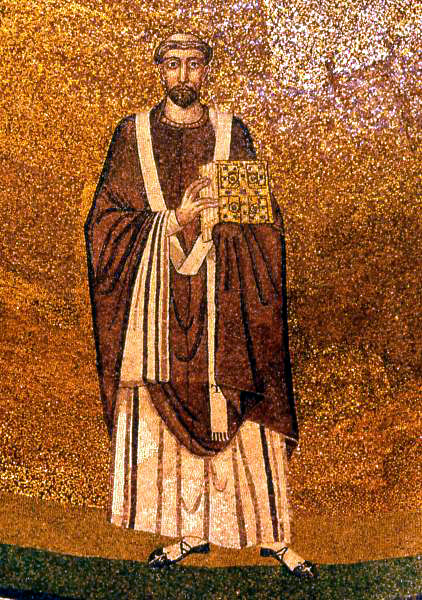
Pope Symmachus
fresco at the Basillica of Sant'Agnese fuori le mura, Rome
Courtesy Wikimedia Commons 
In 498/9, at the beginning of the Middle Ages, Pope Symmachus decreed that if unanimity could not be reached, and if the previous pope had not nominated a successor, then the next pope could be elected by a simple majority. This did not solve the problem of undecided elections, however, and the emperor continued to choose the winner in these cases.  As time progressed, imperial power waned as the power of the cardinals grew, so that by 1059 the laity was officially excluded from the papal elections, and the Cardinals, not the emperor, were the final authority in choosing the pope.  In 1122 at the Concordat of Worms Emperor Henry III formally renounced his role as arbiter in papal elections.  From here forward, secular rulers would have to influence the elections only indirectly, by influencing groups of cardinals.

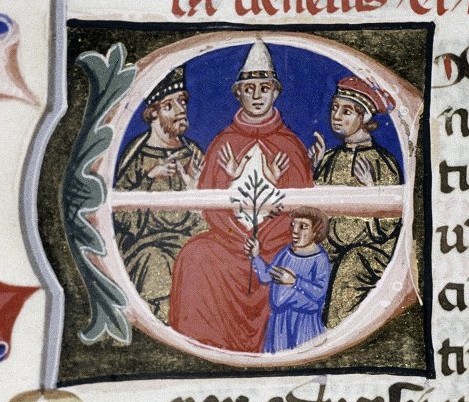
Pope Alexander III, center
14th c. manuscript
Courtesy Wikimedia Commons

Pope Alexander III's Licet de evitanda established the rule of two-thirds majority, and changed the way votes were counted to give all cardinals' votes equal weight.  This rule, established at the Third Lateran Council in 1179, successfully ended the need to defer to secular authority to choose the pope.  Later, Pope Pius wrote concerning the two-thirds rule, "What is done by two-thirds of the sacred college, that is surely of the Holy Ghost, which may not be resisted."

19th c. portrait of Pope Gregory X
Basilica of St. Paul Outside the Walls, Rome
Courtesy Wikimedia Commons
While not as difficult as finding consensus, a two-thirds majority still sometimes took a long time to reach.  Pope Gregory X, at the Council of Lyon in 1274, addressed this problem by introducing the idea of a "conclave."  The first Pope elected by conclave was Innocent V in 1276.  After a temporary suspension, during which papal elections again took a long time to resolve, Pope Celestine V reinstated the procedure.

From 1305-1352 Cardinal-Deacon Jacobus Gaytanus attended five conclaves.  He then wrote Ordinarium Sanctae Romanae Ecclesiae, containing suggestions for elections based on his experiences from the conclaves.  According to Gaytanus, the College of Cardinals used a system of voting similar to modern approval ballots.  That is, there was no limit to either the number of candidates a cardinal could nominate or a limit to the number candidates a cardinal could vote for.  Combining approval ballots with a two-thirds rule (as opposed to a simple majority) meant members of the College usually had to participate in several rounds of voting.  Beginning in 1455, multiple-round candidates needed at least one vote in the previous round of voting to continue to the next round.  This is called "access voting."  Access voting and approval ballots continued to be the way the College elected the pope until 1621, when the Church changed the procedure to categorical voting.

From Imperial appointment to approval ballots, the system of electing a pope underwent several changes during the thousand-year span of the Middle Ages.  The medieval Church was looking for a system that would ensure that the pope was the man God wanted for the job.  Modern Catholics tend to view a papal election in terms of who the cardinals thought would be best for the job.  I wonder which, or both, views the members of the College kept in mind as they cast their ballots for Pope Francis.

Sources:

  • Uckelmen, Joel and Uckelman, Sara L. Strategy and manipulation in medieval elections. Paper given at the COMSOC seminar, Amsterdam, The Netherlands, 28 Oct 2010. University of Amsterdam.(found here)
  • Colomer, Josep M. and McLean, Iain. Electing popes: Approval balloting and qualified-majority rule. Journal of interdisciplinary history, xxix:i (summer, 1998), 1-22. (found here)