 |
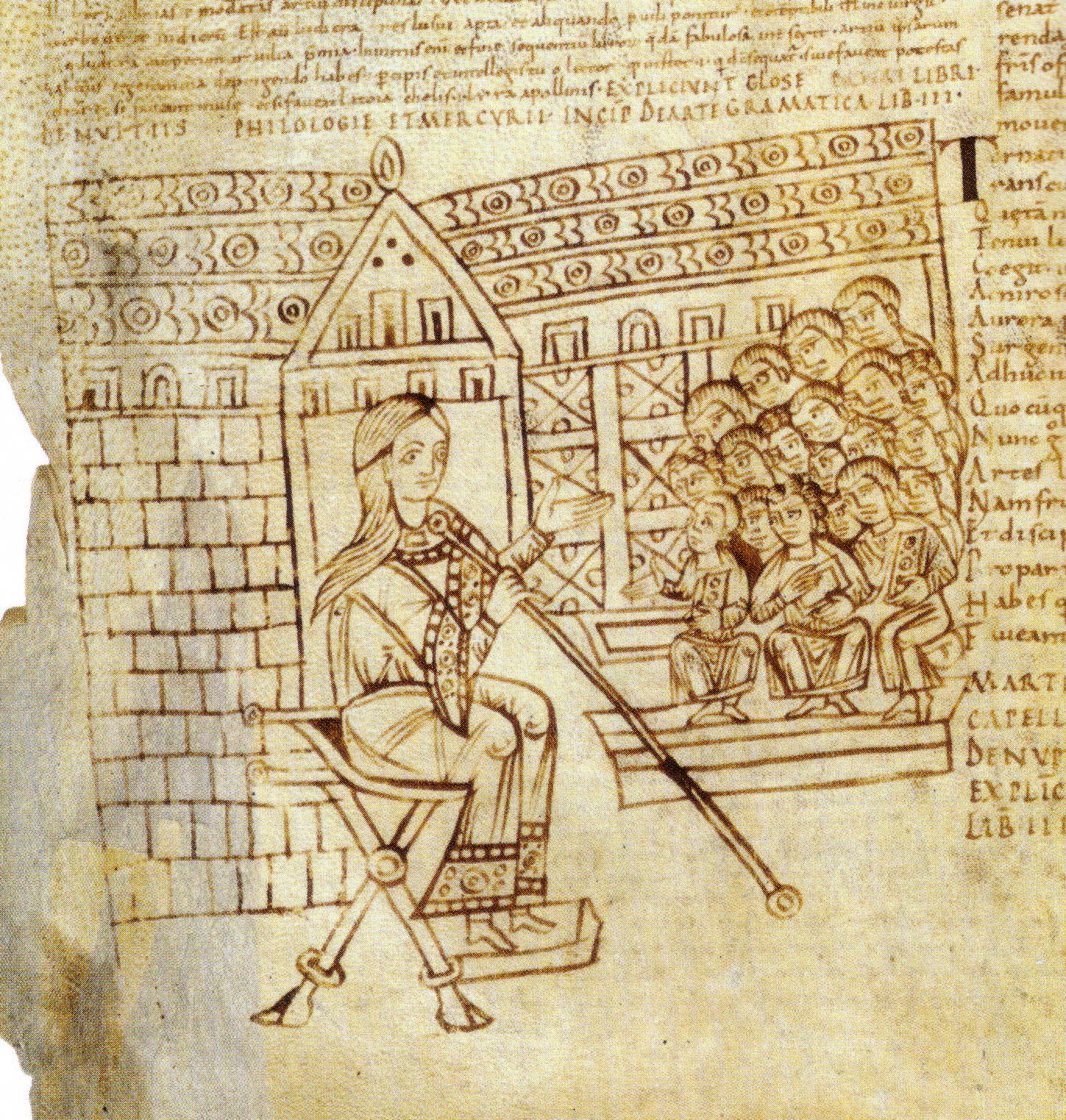
| Lady Grammatica teaches Latin on a 10th c. Carolingian manuscript Image Source: wikimedia commons |
Teacher: I ask you all, why are you so eager to learn?
Students: Because we would not be foolish, as cattle,
knowing nothing but grass and water.
Teacher: And what would you be instead?
Students: We would be wise.
Taken from OE version
of Aelfric’s Colloquy; translation mine.
Objective: To introduce elementary school students
to the culture of Early Medieval Europe, specifically that of Anglo-Saxon
England.
Preparation: Before class begins, divide the class
into 3 groups by placing one of 3 colored sticky notes underneath each
desk/chair.
Attention activity: Introduce the time period with a quiz. For the younger grades, use this worksheet
from BBC Primary History. For the older grades, use a true/false/trick question quiz:
1.
During the middle ages, people ate rotten meat
because they had no refrigeration. They
heavily spiced their food to hide the rotten flavor. (False)
2.
During the middle ages, both boys and girls
could learn to read and write. (True)
3.
During the early middle ages, houses did not
have fireplaces or chimneys. Instead,
they had a hearth in the middle of the room and a hole in the roof for smoke to
escape. (True)
4.
Before Columbus, Europeans believed the world
was flat and if a ship sailed too far it would fall off the edge. (False)
5.
The Roman Empire fell ca. 500 AD. (Trick question: Only the Western half of the Roman Empire
fell then. The Eastern Roman Empire
continued intact until the fall of Constantinople in 1453)
Discussion: Northern Europe experienced a power
vacuum with the collapse of the Western Roman Empire. Ask: if the government of your hometown was
suddenly gone, and you could set up any kind of society you wanted, how
would you do it? Introduce King Aelfred. He described the Anglo-Saxon
society as made up of 3 groups: Those
who fight, those who pray, and those who work.
Tell the students to find their sticky note to learn which group they
are in today.
 |
| My second grader as aetheling. |
Those who fight. Ask one group of kids to stand up. They represent the thanes, or the
nobility. When the king dies, the thanes
elected a new king. Pick one student
from the group to be the tribe’s king (the “thanes” in the older grades can do
this themselves). Give the “king” the
mail shirt. The job of the king was to
protect the people. The thanes gave
fealty to the king, which meant they promised to fight for him and, if he were
killed in battle, they promised that they would die alongside their king. In exchange, the king gave the thanes land,
food, and arm rings.
 |
| My fifth grade daughter posing as abbess. |
Teacher: Wise man, which craft among these seems to be
the greatest?
Wise man: It seems to me God’s service is sovereign of
these crafts, just as one reads in the Gospel,
“First seek God’s kingdom and His righteousness, and all these things
will be added to you.”
Teacher: Which seems to you sovereign of the worldly
crafts?
Wise man: Farming, for the plowman feeds us all.
Taken from the OE
version of Aelfric’s Colloquy; translation mine.
Those who work. Tell the third group of students that
they represent everybody else. Some are
slaves, some freemen. Choose one of
the students to wear a peplos style overdress.
Use Aelfric’s colloquy to introduce Anglo-Saxon occupations.
 |
| My fifth grader, again, this time modeling an overdress. |
Aelfric’s
Colloquy. Aelfric was a monk who
taught Latin classes about the year 1000.
He wrote his Colloquy in Latin
to help his students practice, and also wrote a vernacular (Old English)
translation. The Colloquy presents life
in an Anglo-Saxon village at Aelfric’s time.
The various parts of the Colloquy, presumably assigned to various
students in his class, represent villagers who perform occupations that
Aelfric’s students would have been familiar with. A modern English translation of the Latin
version can be found here.
(An aside: As
written, the entire Colloquy takes
about 30 minutes to read, far too long for most elementary age kids’ attention
spans, so I recommend abridging it. I
cut more out of the version I read to the second graders, and I also reworded
some of the passages. For the fifth
graders, I cut out only the redundant passages, and assigned parts like Aelfric
probably did, so the fifth graders presented a readers’ theater with me reading
the teacher’s parts. During the
presentation in both classes I showed pictures from an Anglo-Saxon calendar illustrating
many of the occupations. The pictures helped keep smaller attention spans from wandering too much. The calendar is
in the collections of the British Library, and images can be viewed at the National Education Network, gallery.nen.gov.uk. Search for "Anglo-Saxon labours of the month." )
What I learned/what I
would do differently: I meant the
quiz at the beginning of the lesson to be merely an introduction to the subject
as well as a fun activity to catch the kids’ attention. It ended
up being essential to my teaching, because I used it to gauge how much
the students already knew about the time period. Answer:
practically nothing, and what they thought they knew was wrong. This showed me quickly that I could assume no
prior knowledge and had to keep the entire presentation basic.
I was surprised at how well the costumes worked as a
teaching tool. Even the older kids
enjoyed dressing up, and the students who didn't get to dress up still wanted to check out the costumes.
Next time I will change the way I teach the Colloquy to the younger students. The fifth graders had a good time with the
readers’ theater, but the eight-year-olds do not yet have the reading skills
necessary for that, so I presented the entire Colloquy myself. Even heavily abridged, it was too much
lecture. I need to find a way to include
more participation. Perhaps I will just show
the pictures from the calendar and ask questions about them: What do you think this person is doing? What could the farmer be growing?
What other animals might the hunter want to catch? Etc.
Final thoughts. I really enjoy this time period. Vikings, knights, Beowulf—what’s not to
enjoy? For me, the most difficult part
of preparing the lesson was narrowing down what I wanted to teach. Six hundred years is tough to cram into sixty
minutes, let alone six hundred years covering the withdrawal of Rome to the
Germanic tribes’ invasions to the birth of England to the Norman Conquest, as
well as the changes in national and religious identity that accompanied the
political changes. Complicating this is
the fact that the modern view of the middle ages, a la Dungeons and Dragons, is fun but anachronistic. I finally decided that the kids weren’t going
to remember much of the history I taught them anyway, and so I concentrated on
the culture. I’m rather pleased with the
way it turned out. I got the students to
think about different ways of setting up governments. The older students even discussed, on their
own, the ethics of a king expecting thanes to die for him. And eight-year-olds in too-big chain mail
shirts are dang cute.
Update (6/5/13): A week after this lesson I taught the classes again, leading the students in an art project inspired by early medieval art (see here for more information). I was afraid that the second graders would finish early, so I had an additional activity for them to do before we began the art project.
Update (6/5/13): A week after this lesson I taught the classes again, leading the students in an art project inspired by early medieval art (see here for more information). I was afraid that the second graders would finish early, so I had an additional activity for them to do before we began the art project.
This is what we did: I
set on the floor enough sheets of construction paper for each child to be able
to turn one over. About half of the
papers had a picture of an Anglo-Saxon artifact paper-clipped to the back of the
construction paper; the others had a blank white sheet paper-clipped to the
back. I showed the students an Indiana Jones hat and told the students that they were archaeologists and they were going to dig
for objects by turning over pieces of construction paper. One at a time, the students came to the front
of the room, put on the hat, and chose a
place to “dig” by turning over a piece of paper. If they found an artifact, the class guessed
what the object might be. The kids
really got into it. They called each
other “Indiana (name)” and whenever a piece of paper was blank underneath they
exclaimed, “Oh, no, you found a booby trap!” instead of being disappointed.